
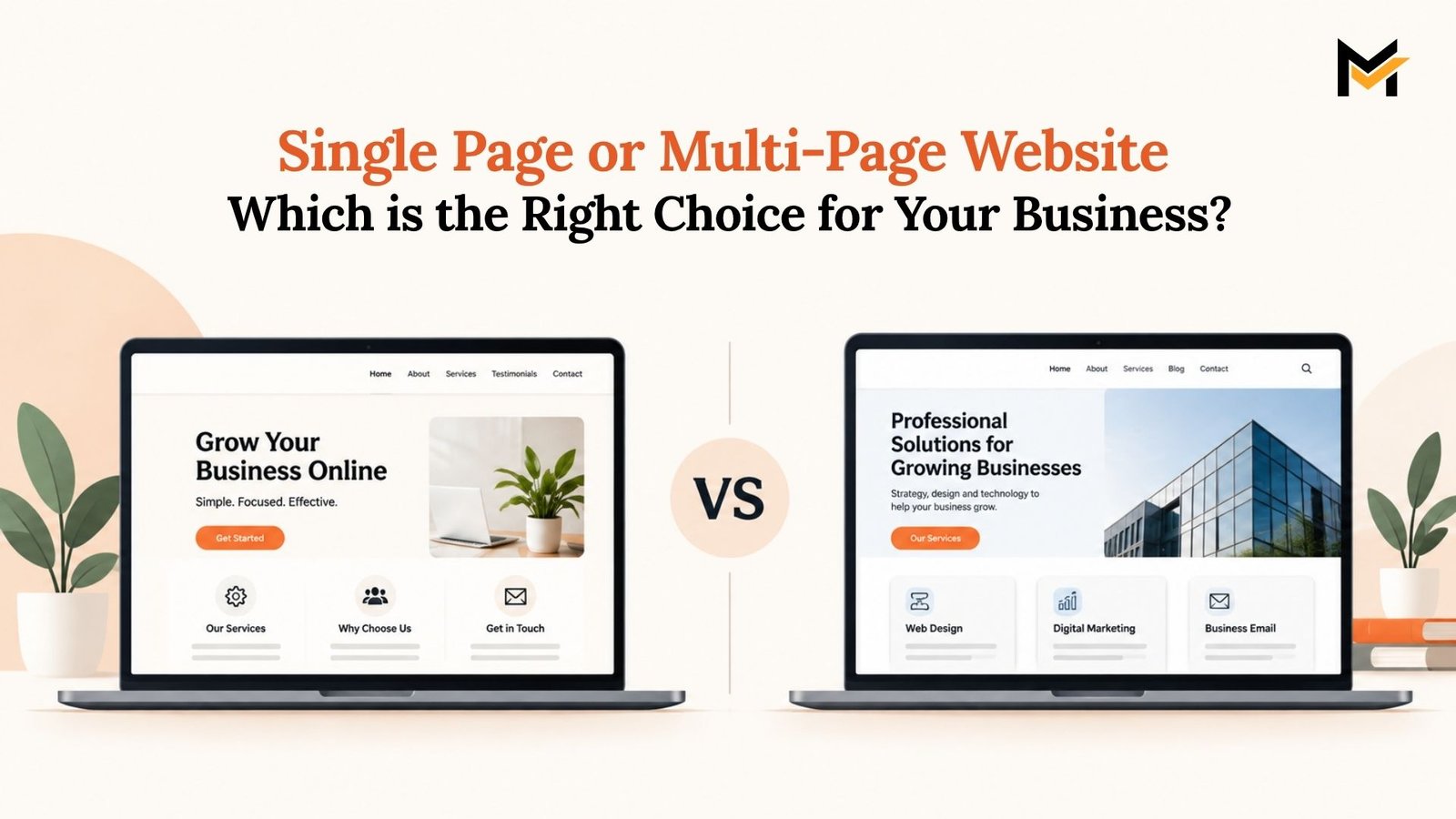
When creating a website for your business, one of the first decisions you need to make is how much content your website actually needs and what kind of website do you really require.
Should you build a single page website that puts everything in one place? Or should you invest in a traditional multi-page website with separate pages for your services, about your business, contact details and other information?
The right choice depends on your business, the amount of information you need to present, your customers’ expectations and what you want your website to achieve.
In this guide, we compare both approaches that will help you decide.
What is a Single Page Website?
A single page website, also called a one-page website, presents most or all of your important business information on one page.
Instead of navigating between multiple pages, visitors typically scroll through sections such as:
- About the business
- Products or services
- Key benefits
- Testimonials
- Contact information
- Enquiry form
- Location or business details
- Call-to-action
Single page website is very popular for many businesses, for example, professional consultants, freelancers, professional service provider or small business that need online presence, that establishes credibility and gives potential customers a way to contact them.
What Is a Multi-Page Website?
A multi-page website separates information into different pages. A typical business website may include multiple pages such as:
- Home
- About Us
- Services
- Products
- Individual service or product pages
- Blog or Knowledge Hub
- Contact
- FAQs
- In some cases terms and policy pages
This structure gives you more space to explain different aspects of your business. It can be particularly useful when you have multiple services, products, locations or customer segments that need their own information.
Single Page vs. Multi-Page Website: At a Glance
| Factor | Single Page Website | Multi-Page Website |
| Structure | One long page | Multiple pages |
| Best suited for | Simple businesses and focused offerings | Businesses with multiple offerings |
| Content | Limited and focused | More detailed |
| Navigation | Scroll-based | Page-based navigation |
| Website design | Simple and focused | More flexible |
| Maintenance | Generally easier | Requires more ongoing management |
| SEO opportunities | More limited | More opportunities for targeted pages |
| Cost | Usually lower | Usually higher |
| Scalability | Limited | Easier to expand |
Neither option is automatically better. The important question is which structure matches your business.
When Should You Choose a Single Page Website?
A single page website can work particularly well when your business has a simple and focused offering.
1. You offer one main service
If your business essentially sells one service, you may not need separate pages for everything. A photographer, professional consultant, freelancer or service provider may be able to explain their offering effectively on one well-structured page.
2. You are a new or small business
If you’re launching a business and primarily need an online presence, starting small can make sense. You can use the website to establish your business online, provide essential information and give potential customers an easy way to contact you.
3. Your main goal is enquiries
If your primary objective is to generate calls, WhatsApp enquiries, form submissions or appointments, a focused single page can keep visitors moving towards that action without unnecessary navigation.
4. You don’t have much content
A website doesn’t need dozens of pages simply because other businesses have them. If you don’t have enough useful information to justify separate pages, a single page can provide a cleaner experience.
5. You want simpler website management
A smaller website generally means fewer pages, fewer pieces of content to maintain and a simpler website management process.
When Should You Choose a Multi-Page Website?
A multi-page website becomes more useful as your business becomes more complex.
1. You offer multiple services
If you provide several services, giving each major service its own page allows you to explain what you offer in greater detail. For example, a digital agency offering website design, SEO, paid advertising and email marketing may benefit from having separate service pages.
2. You have multiple products
Businesses with many products usually need more space to explain their offerings. An eCommerce business, for example, will typically require a much more extensive website structure than a local service business.
3. SEO is an important part of your strategy
A multi-page website gives you more opportunities to create pages around different topics and search intents. For example, instead of trying to rank one page for every service you provide, you can create dedicated pages that address specific customer searches.
This doesn’t mean that simply having more pages automatically improves SEO. The pages still need to provide useful, relevant content.
4. You need to build a content hub
If you plan to regularly publish articles, guides, case studies or other resources, a multi-page website gives you a better structure for organising that content.
5. Your business is expected to grow
If you already know that your website will need additional services, products, locations or content, starting with a scalable structure may save you from having to redesign the website later.
Important Consideration: Website Design
Website design matters just as much.
A single page website can become difficult to use if everything is simply placed one section after another without a clear structure. Similarly, a multi-page website can become confusing if visitors cannot easily find the information they need.
Regardless of the structure, your website should make it easy for visitors to understand:
- Who are you?
- What do you offer?
- Why should they consider you?
- How can they contact you?
A good website design should make these answers easy to find.
Also read: Best Platforms to Create a Business Website in India
Which Website Is Better for a Small Business?
For many small businesses, when planning to launch a website, the decision comes down to what the website needs to accomplish today and the availability of content at that time.
- If you have less content and primarily need an online presence with your business information, services, contact details and enquiry options, a single page website may be enough.
- If you have multiple services, products, locations or a strong content and SEO strategy, a multi-page website may be more appropriate.
Don’t worry any decision you take now isn’t permanent. A business can start with a simple single page website and expand it as its needs grow.
Ask Yourself these Five Questions
1. How many services or products do I offer?
One or two → A single page may be sufficient.
Many → Consider a multi-page website.
2. Are you planning to start with SEO instantly?
No → A single page may work.
Yes → A multi-page structure gives you more flexibility.
3. Will you publish content regularly via blogs?
No → A single page may be enough.
Yes → A multi-page website is likely to make more sense.
4. Do customers need detailed information before contacting me?
No → Keep it simple – single page website.
Yes → Go for multi-page website. Separate pages can make information easier to organise.
5. Will my business website need to grow significantly in short term?
If yes, consider a structure that can accommodate additional pages and content.
Single Page or Multi-Page Website: What Should You Choose?
There is no rule that says every business needs a large website.
For a small business with a focused offering, a well-designed single page website can provide everything customers need without unnecessary complexity.
For businesses with multiple services, products, content or more ambitious SEO goals, a multi-page website provides greater flexibility.
The best website isn’t necessarily the one with the most pages. It’s the one that gives your customers the information they need and makes it easy for them to take the next step.
Frequently Asked Questions
Is a single page website good for a small business?
Yes. A single page website can work well for small businesses with a focused offering, limited content and a straightforward goal such as generating enquiries or providing essential business information.
Is a one-page website good for SEO?
It can rank for relevant searches, but a single page provides less scope to target multiple topics and search intents compared with a well-structured multi-page website.
Is a multi-page website better than a single page website?
Not necessarily. The right option depends on your current business needs, available content, the service you offer and your digital marketing plans.
Can I convert a single page website into a multi-page website later?
Yes. A business can start with a single page and expand its website as its content, services and SEO requirements grow. It is useful to plan the initial website structure with future expansion in mind.
How much does website design cost for a small business?
The cost varies significantly depending on the platform, design requirements, number of pages, functionality and ongoing maintenance. A single page website with domain and hosting can cost in the range of ₹9000 – ₹15000 whereas a multi-page website with domain and hosting can cost in the range of ₹25000 – ₹75000 – this does not include yearly recurring cost to ensure your website is running.
If you’re a small business that simply needs a professional online presence without the complexity of building and managing a larger website, our Business Startup Kit can also be worth considering.
Starting at just ₹1125 /month* Business Startup Kit from Magic Mails is an all in one solution which includes domain name, professional email addresses, single page website and more.